Trust PPIUD (Postpartum TCu 380A)
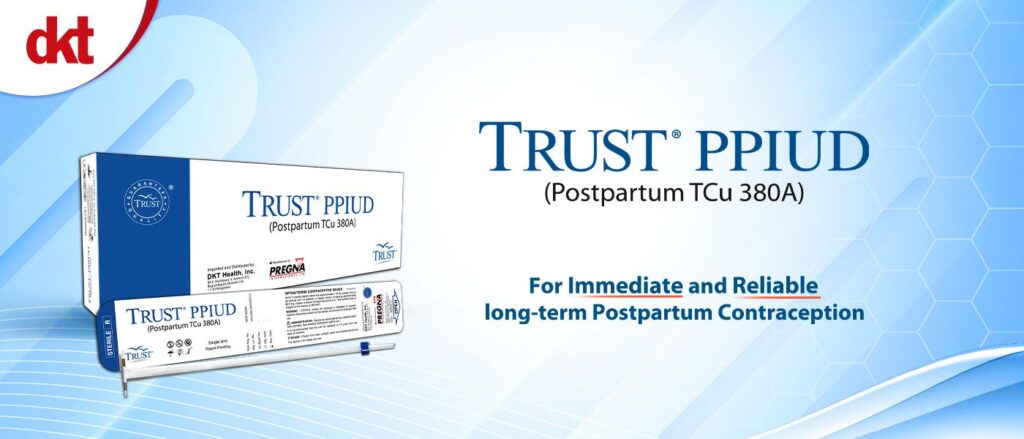
Each T-shaped plastic frame has approximately 176 mg. copper wire on its vertical arm. In addition, a copper sleeve containing approximately 66.5 mg. copper is placed on each horizontal arm. Total surface area of copper on the device is 380 mm2
Generic Name: Postpartum TCu 380A
INDICATION: PPIUD [ Postpartum IUD Copper T 380A ] is indicated for conception control.
TIMING OF IUD INSERTION (PPIUD)
The usual timings are:
- Postplacental: Insertion after expulsion of the placenta following a vaginal delivery on the same delivery table
- Within 48 hours after delivery: Insertion within 48 hours of vaginal delivery and prior to discharge from the postpartum ward
TYPES OF INSERTION [PP IUD]
- Postplacental: Postplacental insertion of the IUD is done immediately following delivery of the placenta. The woman is not yet shifted from the delivery table. The insertion takes place immediately following active management of third stage labor and the delivery of the placenta.
- Postpartum within 48 hours: the IUD is inserted within 48 hours following the birth of the baby. The trained provider can insert the IUD in a procedure or examination room in the postpartum ward by using PPIUD Inserter
WHO CAN USE IT
Most postpartum women can safely use the IUD, including those who are young, breastfeeding, or doing hard work. It is especially good for women who think they do not want any more children, but want to delay sterilization until they are certain.
HEALTH BENEFITS
The IUD is very safe at preventing pregnancy. This gives the mother time to take care of her and the baby’s health
SIDE EFFECTS
Copper-bearing IUDs (e.g., the Copper T) have fewer side effects than hormonal methods (e.g. the pill), but sometimes cause an increase in the amount, duration, and painfulness of menstrual periods
These symptoms are usually not noticed by postpartum women, especially those who are breastfeeding, because they lessen or go away spontaneously in the first few months after insertion
POSSIBLE RISKS
When it is inserted immediately postpartum, about 5-10 women out of 100 will find that the IUD has fallen out during the first three months. If this happens, she should return to the healthy facility and have another IUD inserted to continue protection against pregnancy.
The IUD offers no protection against HIV or other STIs. Only barrier methods (e.g. the condom) help protect against exposure to HIV and other STIs.
If the woman thinks that she has a “very high personal risk” for certain STIs, she should not use the IUD.
MODE OF ACTION
The IUD interferes with the ability of sperm to survive and to ascend the fallopian tubes where fertilization occurs. It alters or inhibits sperm migration, ovum transport and fertilization. It stimulates a sterile foreign body reaction in endometrium potentiated by copper.
EFFECTIVENESS
The IUD is effective as soon as it is inserted. The IUD is one of the most effective and long-lasting contraceptive methods. IUD is comparable to female sterilization and male sterilization in contraceptive effectiveness.
The Cu T 380A IUD is highly effective (>99% effective). There are 0.6 to 0.8 pregnancies per 100 women in the first year of use.
The Cu T 380A IUD is effective for 10 years of continuous use. It can, however, be used for whatever time period the woman wants, up to 10 years.
RETURN TO FERTILITY
A woman’s fertility returns promptly after an IUD is removed. This message should be made very clear to clients having an IUD removed i.e. they should have another IUD inserted immediately after removal (if desired and appropriate) or immediately start another contraceptive method unless they want to get pregnant.
LIMITATIONS
The specific limitations of an IUD placed in the postpartum period include:
- Relatively higher risk of spontaneous expulsion, as compared to interval IUD. The skilled clinicians with right technique of insertion are associated with lower expulsion rates
- Perforation of the uterus while placing a PPIUD immediately after delivery of placenta or during the first 48 hours postpartum is unlikely because of the thickness of the uterine wall in the postpartum period. No such cases are reported in the literature.
- Requires a skilled and trained healthcare professionals provider for insertion and removal of the device
- Does not protect against STIs/HIV
- Cannot be inserted in women with active RTI/STI
Manufactured by:
Pregna International Ltd.
Plot No. 219, Survey No. 168
Dabhel Industrial Co-Operative Society Ltd.,
Dabhel, Daman (U.T.) – 396 210 – India
Imported and Distributed by:
DKT Health, Inc.
80 E. Rodriguez Jr. Avenue (C5),
Bagumbayan, Quezon City
1110 Philippines