Levoplant® Implant
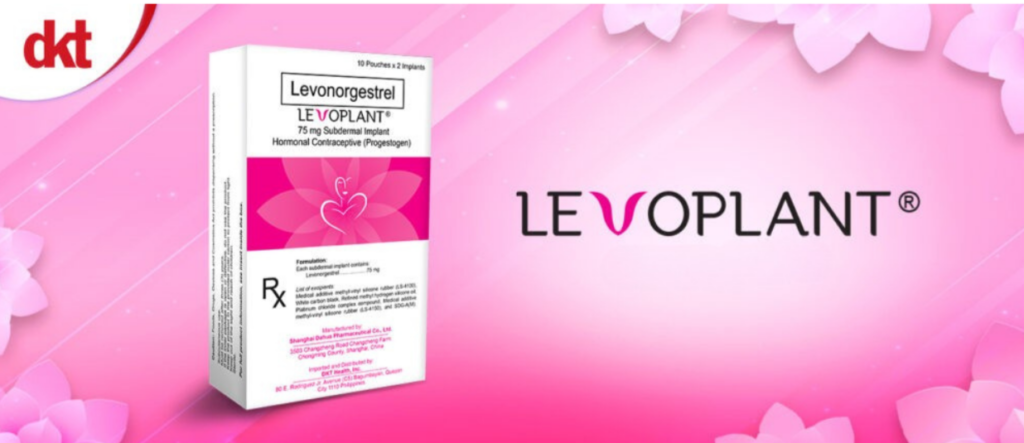
Generic Name: Levonorgestrel
Formulation:
Each subdermal implant contains:
75mg Levonorgestrel
Each box contains 10 pouches x 2 implants
INDICATION
Used to prevent pregnancy
DOSAGE AND ADMINISTRATION
Each rod contains 75 mg of levonorgestrel, for a total of 150 mg.
Subcutaneous use. Must be removed after three (3) years.
PHARMACOLOGIC CATEGORY
Hormonal Contraceptive (Progestogen)
PRODUCT DESCRIPTION
Levonorgestrel (Levoplant® ) is used for the prevention of pregnancy (contraception). The implants consist of two thin, flexible rods made of a rubber-like material, that are inserted by a minor surgical procedure just beneath the skin on the inside of your upper arm. The implants slowly release a small amount of the hormone levonorgestrel, which is one of the active ingredients in many oral contraceptives. Levonorgestrel (Levoplant® ) is long-acting and is effective for up to three years. Immediately after insertion, low doses of the hormone start to be released continuously into your body. Levonorgestrel (Levoplant® ) works by a combination of factors. The most important of these are prevention of regular egg release and thickening of the cervical mucus, making it more difficult for sperm to reach the egg.
FORMULATION
The active substance is levonorgestrel. Each implant contains 75 mg levonorgestrel. The other ingredients are: Medical additive methyl-vinyl silicone rubber (LS-4100), White carbon black, Refined methyl hydrogen silicone oil, Platinum chloride complex compound, Medical additive methyl-vinyl silicone rubber (LS-4150), and SDG-A(M).The set contains two flexible, sealed, white or off-white rod-like implants, about 44 mm in length and 2.4 mm in diameter.
PHARMACODYNAMICS AND PHARMACOKINETICS
Pharmacodynamic Properties
Pharmacotherapeutic group: Progestogens, levonorgestrel
The active ingredient in Levonorgestrel (Levoplant® ), levonorgestrel, is a synthetic progestin. The primary pharmacologic action of levonorgestrel is its anti-fertility effect. Levonorgestrel has been shown to affect ovarian function in various ways. This ranges from: the absence of follicular and luteal activity to normal follicular activity but deficient luteal activity to normal ovulatory patterns. Levonorgestrel causes thickening of the cervical mucus, thus preventing the passage of spermatozoa into the uterus. It also suppresses the endometrium and may prevent implantation of the blastocyst.
Pharmacokinetic Properties
Absorption
Levonorgestrel is released from the Levonorgestrel (Levoplant® ) directly into tissue fluid. Maximum plasma levonorgestrel concentrations of approximately 833 ± 367 pg/ml are reached about 5.4 days after insertion. After the initial phase, levonorgestrel concentrations decline to 430 ± 205 pg/ml within one month, 351 ± 210 pg/ml within six months, 311 ± 197 pg/ml within one year. Plasma levonorgestrel concentrations are inversely related to body weight. However, due to the great variation in plasma levonorgestrel concentrations and in individual response, plasma concentrations alone are not predictive of the risk of pregnancy in an individual woman. Considerable inter- and intra- individual variation occurs, and serum drug concentrations are affected by individual clearance rates and body weight, among other factors. In Levonorgestrel (Levoplant® ) users, plasma levonorgestrel concentrations are substantially below those observed in women taking oral contraceptives containing levonorgestrel.
Distribution
Levonorgestrel in serum is primarily protein bound. Approximately half is bound to sex hormone binding globulin (SHBG) and half to albumin. SHBG concentrations are depressed by levonorgestrel within a few days of administration, with resultant decreases in circulating levonorgestrel concentrations.
Metabolism
Levonorgestrel metabolic pathways have been only partially delineated 16β– hydroxylation is an identified pathway of metabolism. Concentrations of metabolites in circulation soon exceed those of levonorgestrel, mostly as conjugated sulfates. Metabolic clearance rates may differ among individuals by several fold, which is believed to account also in part for the wide variation observed in levonorgestrel serum concentrations among implant users.
Excretion
The elimination half-life of levonorgestrel is approximately 13 to 18 hours. Levonorgestrel and its metabolites are primarily excreted in the urine (40% to 68%) and about 16% to 48% are excreted in feces. After removal of the implants, levonorgestrel concentrations decrease below 100 pg/mL by 96 hours and below sensitivity of the assay by 5 days to 2 weeks.
METHOD OF ADMINISTRATION
Instructions for insertion and removal of the implants
One Levonorgestrel (Levoplant® ) pouch contains two sterile rods. Only health care providers trained in both insertion and removal should perform these procedures. Aseptic technique must be followed during implant insertion and removal to prevent infection. Contaminated waste must be properly disposed of and instruments and other items should be decontaminated, thoroughly cleaned, and sterilized by autoclaving or dry heat, or high- level disinfected.
Preparation for implant insertion
The following sterile instruments and supplies are needed for insertion of implants:
- Sterile dry surgical drape
- Sterile tray for equipment
- Bowl of antiseptic soaked cotton balls
- Sterile pair of surgical gloves (free of talc)
- 3-5 ml syringe and a 5-5.5 cm long needle (22-gauge)
- Filter needle (if local anesthetic is supplied in glass ampule)
- Scalpel with blade
- Tweezers
- Skin closure or adhesive bandage or gauze with surgical tape
- Gauze and compress
- Set of two rods in sterile pouch
The following non-sterile supplies are recommended for insertion of implants:
- Examining table for the patient to lie on
- Soap for washing the arm
- Ballpoint pen or marker
- Antiseptic solution for the skin
- 2 mL local anesthetic
Getting ready for insertion procedure:
- Explain the procedure to the client and encourage questions
- Determine that required sterile or high-level disinfected instruments and implants are present
- Wash hands thoroughly and dry them
- Check to be sure that the client has thoroughly washed and rinsed her entire arm
- Position the woman’s arm and place a clean, dry cloth under her arm
- Mark position on arm for insertion of rods 6 cm to 8 cm the elbow folder (this should form a “V” pattern)
- Put on a sterile pair of hand gloves
Pre-insertion
- Set up a sterile field and place implant rods and trocar on it
- Prep insertion site with antiseptic solution
- Place sterile or high-level disinfected drape over arm
- Inject 2 mL of local anesthetic applied just under the skin, raising a wheal at the insertion point and advancing up to 5 cm along the first insertion track, injecting 1 mL of local anesthetic along the track as you withdraw. Without completely removing the needle, reorient to the second insertion track, advance up to 5 cm, and again inject 1mL of local anesthetic along the track as the needle is withdrawn. Let the arm rest for approximately 5 minutes and check for anesthetic effect before making skin incision.
Implant insertion instructions
Step 1: Make a small incision with a scalpel in the skin on the inside of the upper arm. Alternatively, use the trocar to puncture the skin. Insert the tip of the trocar beneath the skin at a shallow angle. Gently advance the trocar superficially under the skin with the bevel facing up while tenting the skin. Tenting of the skin enables the implant to be placed under the skin and not deeper into the arm
The rod should be placed parallel to the skin. Take great care not to insert trocar into the arm muscle. Note: The trocar has two marks on it. The mark closest to the hub indicates how far the trocar should be introduced under the skin to place the implants. The mark closest to the tip indicates how much of the trocar should remain under the skin following placement of the first implant.
Step 2: When the trocar has been inserted to the mark closest to the hub, remove the obturator and load the first implant into the trocar, using thumb and forefinger.
Step 3: Using the obturator to push, gently advance the implant towards the tip of the trocar until you feel resistance. Never force the obturator.
Step 4: Holding the obturator stationary, withdraw the trocar to the mark closest to the trocar tip. The implant should be released under the skin at this point. It is important to keep the obturator stationary and to avoid pushing the implant into the tissue. Do not completely remove the trocar until both implants have been placed.
Step 5: To place the second implant, align the trocar so that the second implant will be positioned at about a 30 angle relative to the first implant. Repeat steps 3-4. The rods are placed in the shape of a V opening toward the shoulder. Leave a distance of about 5 mm between the incision and the tips of the implants. Remove the trocar and immediately dispose of it in a sharps container.
Post-insertion
- Remove drape and wipe the client’s skin with alcohol
- Bring edges of incision together and close it using surgical tape, then cover it with tape on a sterile gauze (2×2) or an adhesive bandage
- Instruct client regarding wound care:
- Keep the area around the insertion site dry and clean for at least 48 hours
- Leave the gauze pressure bandage in place for 48 hours and the surgical tape or adhesive bandage in place until the incision heals (normally 3-5 days)
- Apply pressure dressing snugly
- Discuss with the client what to do if she experiences any problems following insertion or side effects from the implant
- Advise client that she can have the rods removed at any time if she desires
- Make return visit appointment, if necessary
- Observe the client for at least 15-20 minutes before discharging
Implant Removal
Levonorgestrel (Levoplant®) should be removed after 3 years of use.
The implants can be removed, for personal or medical reasons, at the request of the client at any time. The implants should be removed by the end of the third year. Removal of implants can be done at any time in the menstrual cycle.
Preparation for implant removal
The following items are needed for removal:
- Examining table for the woman to lie on
- Soap for washing the arm
- Ballpoint pen or marker
- Sterile dry surgical drape
- Bowl for the antiseptic solution
- Pair of sterile surgical gloves
- Antiseptic solution for the skin
- 2 mL local anesthetic
- Sterile tray for the equipment
- Sterile 3-5 ml syringe and a 2.5-4 cm long needle (22-gauge)
- Scalpel with #11 blade
- 1 curved and 1 straight Crile or Kelly forceps
- 1 tissue forceps (optional)
- Skin closure or adhesive bandage or sterile gauze with surgical tape
Removal procedure
Getting ready for removal procedure:
- Determine that required sterile or high-level disinfected instruments are present
- Check that the client has thoroughly washed and rinsed her arm
- Explain the procedure to the client and encourage questions
- Position the woman’s arm and place a clean, dry cloth under her arm
- Palpate the rods to determine the point of removal
- Mark position on arm where the tip of the rods is palpated
Pre-removal
- Wash hands thoroughly and dry clean them
- Put on a sterile pair of hand gloves
- Arrange instruments and supplies
- Prep removal site with antiseptic solution twice
- Place sterile or high-level disinfected drape over the arm
- Inject 1ml of local anesthetic applied at the incision site and under the end of the rods
- Check for anesthetic effects before making a skin incision
Implant removal
Step 1: Before starting the removal, the implants must be located by palpation with ungloved fingers and the position of each rod marked. To help view the proximal tip near the insertion incision (bottom of the V), push down on the distal end of the implant. After cleaning the skin with an antiseptic, a small amount of local anesthetic is infiltrated under the implant ends. Anesthetic injected over the implants may obscure their position and make removal more difficult.
Step 2: A small skin incision of 2-4 mm is made close to the ends of the implants (below the bottom of the V). Do not make a large incision.
Step 3: Push each implant gently with your fingers towards the incision. When the tip is visible in the incision, grasp it with the straight Crile/Kelly forceps and gently pull out the rod without twisting or pulling on the rod, as this may lead to rod breakage.
If the tip of the implant does not become visible in the incision, gently insert the curved Crile/Kelly forceps into the incision, trying to grasp the implant. Flip the forceps over with your other hand and with the scalpel, carefully dissect the tissue around the implant to expose it and then grasp the implant with the straight Crile/Kelly forceps. The implant can then be removed, being careful to avoid a twisting or pulling motion.
If the implant is encapsulated, grasp and stabilize the exposed rod with the curved Crile/Kelly forceps. Use the scalpel to very gently make a small incision into the tissue sheath to expose the tip of the rod. Use the tip of the scalpel to gently separate the encapsulated tissue from the rod, moving distally, keeping light but steady traction on the rod until the rod is completely freed from the tissue.
After the procedure is completed, close the incision and bandage it as after insertion. The arm should be kept dry for 24-28 hours
CONTRAINDICATIONS
- Hypersensitivity to levonorgestrel or to any other component of Levonorgestrel (Levoplant®)
- Current (history of) breast cancer
- Other diagnosed or suspected sex hormone-dependent neoplasia
- Severe liver disease, infection, or tumor
- Thromboembolic disease
- Unexplained vaginal bleeding
- Systemic lupus erythematous with positive or unknown antiphospholipid antibodies
PRECAUTIONS
- Before initiating or reinstituting treatment, a complete medical and family history should be taken. Blood pressure should be measured and a physical examination should be performed, guided by the contraindications and warnings and precautions for use. The woman should also be instructed to carefully read the user leaflet and to adhere to the advice given and to contact her physician if any problems occur at the insertion area. The frequency and nature of examinations should be based on established practice guidelines and be adapted to the individual woman.
- The insertion area should be examined at every control visit. If undiagnosed, persistent or recurrent vaginal bleeding occurs, appropriate measures should be taken to rule out malignancy.
- Women with a family history of breast cancer or who have benign breast nodules or mastopathy should be monitored with particular care.
ADVERSE REACTIONS
The following undesirable effect has been reported during the pivotal clinical trial with Levonorgestrel (Levoplant® ):
Very common (occurring in more than 10% of users): Breakage of the implant during or near removal.
The following very common undesirable effects have also been reported during clinical trials with LNG-releasing implants including Levonorgestrel (Levoplant® ):
Disturbance of menstrual bleeding patterns, such as frequent, irregular, or prolonged menstrual bleeding, spotting, oligomenorrhoea, or amenorrhea, are the most common undesirable effects, occurring in the majority of users during the first year. Other very common undesirable effects are: headache, nervousness, dizziness, nausea, cervicitis, vaginal discharge, genital pruritus, pelvic pain, breast pain, and weight gain.
Manufactured by:
Shanghai Dahua Pharmaceutical Co., Ltd.
3503 Changzheng Road Changzheng Farm
Chongming County, Shanghai, China
Imported and Distributed by:
DKT Health, Inc.
80 E. Rodriguez Jr. Avenue (C5),
Bagumbayan, Quezon City
1110 Philippines