Trust Copper T IUD (TCu 380A)
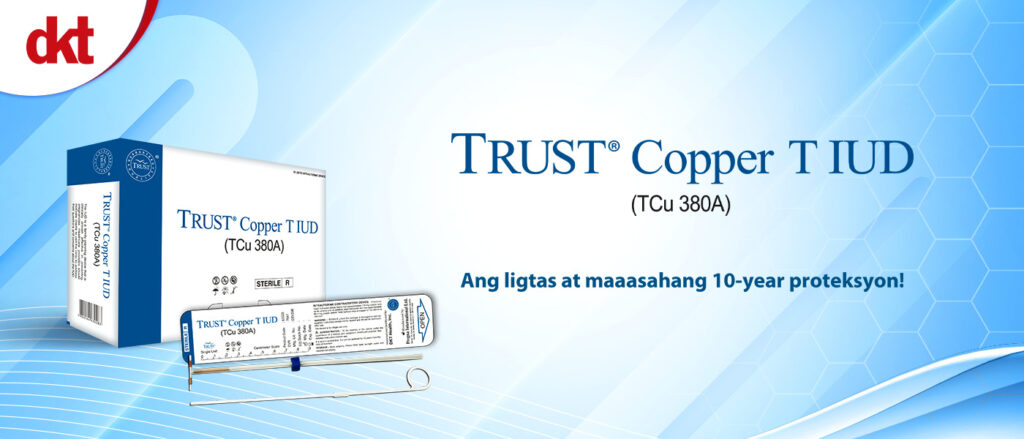
The copper-bearing IUD is a small, flexible frame with copper sleeves or wire around it, and is being used as an effective method for family planning. The effectiveness of TCu 380A IUD lasts for 10 years.
Each T-shaped frame has approximately 176 mg copper wire on its vertical arm. In addition, each horizontal arm has approximately 66.5 mg copper sleeve. Total surface area of copper on the device is 380 mm2
Generic Name: TCu 380A
INDICATION: Copper T IUD [TCu 380A ] is indicated for conception control.
PROCEDURE FOR INSERTION
A) PREPARING THE USER
1) The provider should wear sterile gloves and use aseptic techniques.
2) Prior to insertion:
- The vagina and cervix should be cleansed with an antiseptic solution.
- The uterine cavity should be visualized by means of a speculum and its anterior wall grasped with a tenaculum.
- Gently traction the tenaculum until the cervix aligns with the uterine cavity.
3) Measure the length of the uterine cavity and confirm that the measurement is within the range allowed by the Copper T.
B) LOADING THE TCu 380A
Do not open the sterile package or bend the arms of “T” into the insertion tube until immediately before it is introduced into the uterus. The Copper T can be prepared for insertion inside the sterile package as per the instructions given below.
- Ensure that the vertical arm of “T” is fully inside the insertion tube and the opposite end of the insertion tube will be closed to the package bottom seal.
- Place the package on a clean, hard flat surface with the clear plastic side up. Partially open the package from the end marked “OPEN”, approximately halfway to the flange depth gauge.
- Hole the package with open end up, and the flaps away from each other. Put the white solid rod into the insertion tube to almost touch the bottom of the “T”. Be careful not to touch the tip of solid rod or brush it against another surface as this could lead to the white solid rod losing its sterility.
- Place the package on the clean, hard flat surface once again with the clear plastic side up.
- Through the plastic clear cover, place your thumb and index finger over the ends of the horizontal arms of the “T” and bend the arms towards the stem of the “T” as indicated on the package label insert. Use your other free hand to push the insertion tube against the arms of the “T”. Note that the arms should not be bent until 5 minutes before insertion.
- Complete the bending of the arms of the “T” by bringing the thumb and index finger together while using the other hand to maneuver the insertion tube to pick up the arms of the “T”. Insert the folded arms of the “T” into the arm insertion tube only as far as necessary to ensure the retention of the arms. Do not try to push the copper bands (sleeves) of the “T” arms into the insertion tube, they will not fit.
- Adjust the movable flange depth gauge with the help of scale printed on label insert or use the preprinted scale on the insertion tube so that it indicates the depth of the uterus (as measured earlier by uterine sound). The flange should be positioned so that it is on the same plane as the arms of the “T”.
- The TCu 280A is now ready for insertion. Peel the remaining cover of the package and lift the loaded insertion tube, keeping it horizontal so that the “T” or white solid rod does not fall out. Be careful not to dislodge the “T” by any unsterile surface that may contaminate it.
INSERTING THE LOADED TCu 380A
- Gently introduce the loaded insertion assembly through the cervical canal and advance upwards until the “T” lies in contact with the fundus, and flange comes in contact with the cervix. Ensure that the flange is in the horizontal plane.
- Holding the white solid rod stationary by one hand, withdraw the insertion tube by your free hand not more than ½ inch. This releases the arms of the “T”.
- Once the arms have been released, carefully push the insertion tube upwards, towards the top of the uterus until you feel a slight resistance. This step ensures that the arms of the “T” are as high as possible in the uterus. Excessive force could cause perforation of the fundus.
- Gently withdraw first the white solid rod (hold the insertion tube stationary while removing the white solid rod), and then the insertion tube from the cervical canal. Cut the threads so that they protrude only 3-4 cm into the vagina.
- Assist the woman from the table slowly. Be alert to possible dizziness. Instruct her how and when to check threads. Have her check the threads. Invite questions and instruct her about return visits as well as what to do, whom and how to contact for help if needed.
REMOVAL INSTRUCTIONS
Copper T must be removed by a trained health care provider. This can be done easily and safely in the clinic and takes only a few minutes. Removal is effected by pulling gently one of the exposed threads. Excessive force in pulling the threads could result in breakage of threads. Some cramping or bleeding may be experienced during removal.
SIDE EFFECTS
Copper-bearing IUDs (e.g., the Copper T) have fewer side effects than hormonal methods (e.g. the pill), but sometimes cause an increase in the amount, duration, and painfulness of menstrual periods
These symptoms are usually not noticed by postpartum women, especially those who are breastfeeding, because they lessen or go away spontaneously in the first few months after insertion
POSSIBLE RISKS
- Longer and heavier menstrual periods, or bleeding or spotting between periods may occur during the first weeks after insertion. If they continue or are severe, visit the health care provider.
- Cramping may occur following insertion, usually for a short time, but could last for several hours up to a few days. This can be relieved by taking mild analgesic tablets, using hot compress on abdomen, and/or exercising moderately.
- Check periodically, and particularly after menstruation, to make certain that the threads still protrude from the cervix. If threads are missing, shorter or longer, return to the clinic.
- If Copper T is expelled, return to the clinic. There is no continuing protection after expulsion.
- Return to the clinic for check-up for replacement of the Copper T (end of ten years after insertion), or removal of the Copper T if the user so decides to get pregnant within the 10-year period.
- If period is delayed (with symptoms of pregnancy, such as nausea, tender breasts, etc.) report immediately to the clinic.
- If there is abdominal pain, pain during intercourse, infections (such as gonorrhea), abnormal discharge, fever, and chills, consult a physician.
The IUD offers no protection against HIV or other STIs. Only barrier methods (e.g. the condom) help protect against exposure to HIV and other STIs.
If the woman thinks that she has a “very high personal risk” for certain STIs, she should not use the IUD.
MODE OF ACTION
TCu 380A IUD works primarily by preventing the meeting of sperm cell and egg cell. The copper device causes a chemical change in the uterus which makes it hard for the sperm cell and egg cell to move through the woman’s reproductive tract. This condition reduces the ability of the sperm to fertilize the egg cell. The continuous copper release in the uterine cavity from the copper wire and copper sleeves enhances the contraceptive effect of TCu 380A.
EFFECTIVENESS
Trust Copper T IUD is effective as soon as it is inserted. The IUD is one of the most effective and long-lasting contraceptive methods. IUD is comparable to female sterilization and male sterilization in contraceptive effectiveness.
The Cu T 380A IUD is highly effective (>99% effective). There are 0.6 to 0.8 pregnancies per 100 women in the first year of use.
The Cu T 380A IUD is effective for 10 years of continuous use. It can, however, be used for whatever time period the woman wants, up to 10 years.
RETURN TO FERTILITY
A woman’s fertility returns promptly after an IUD is removed. This message should be made very clear to clients having an IUD removed i.e. they should have another IUD inserted immediately after removal (if desired and appropriate) or immediately start another contraceptive method unless they want to get pregnant.
Manufactured by:
Pregna International Ltd.
Plot No. 219, Survey No. 168
Dabhel Industrial Co-Operative Society Ltd.,
Dabhel, Daman (U.T.) – 396 210 – India
Imported and Distributed by:
DKT Health, Inc.
80 E. Rodriguez Jr. Avenue (C5),
Bagumbayan, Quezon City
1110 Philippines